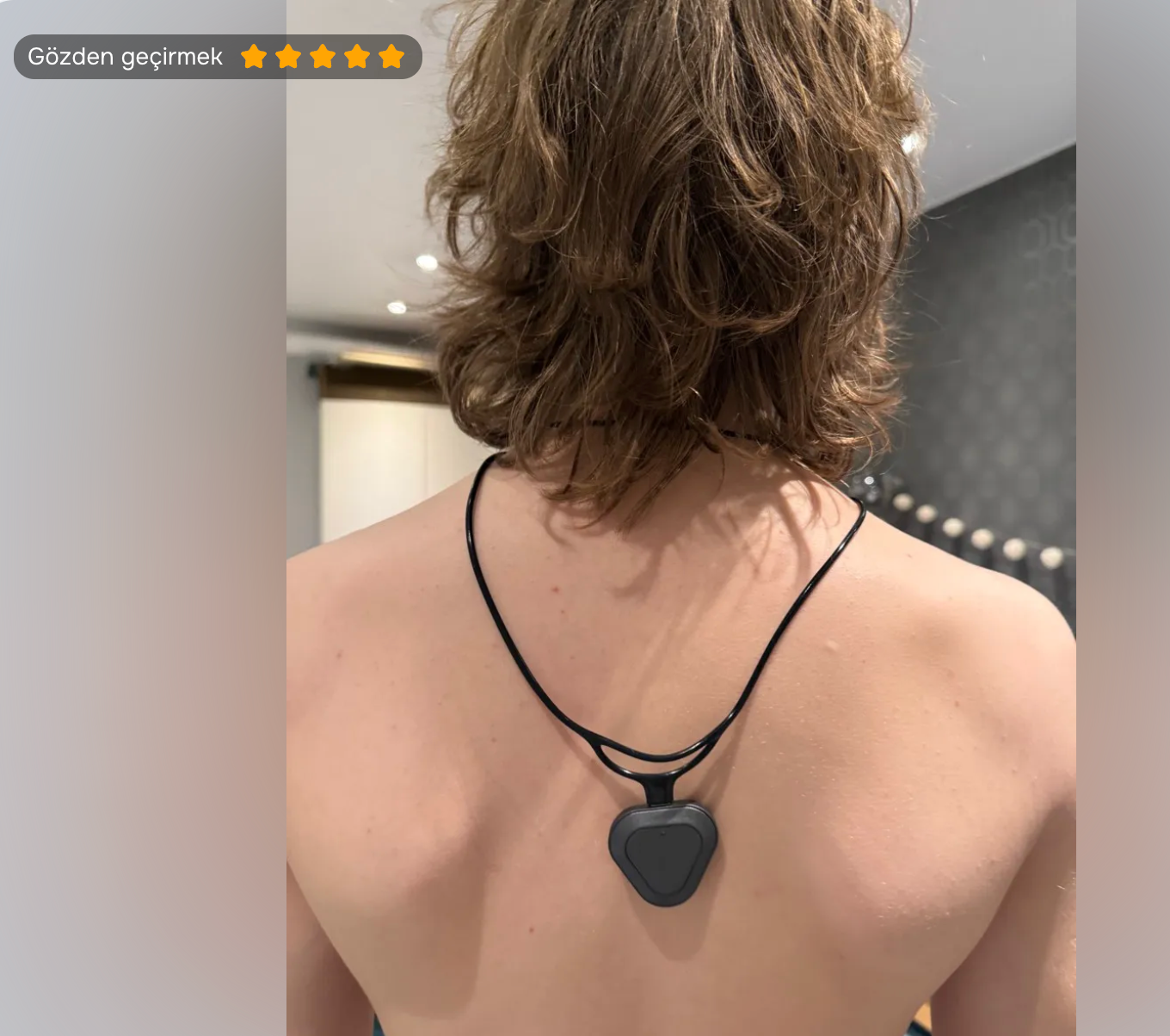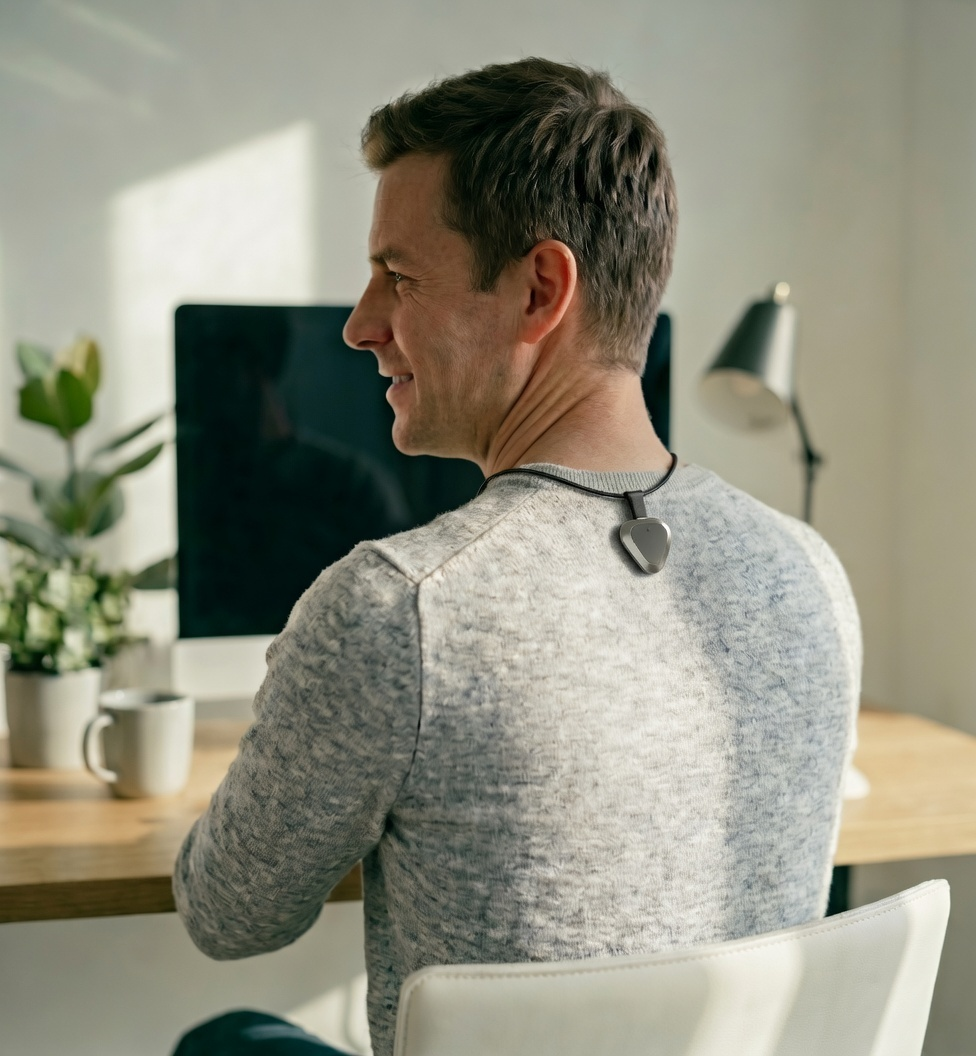
Imagine clipping a tiny device to your upper back. Within seconds, it knows exactly when you slouch. A gentle vibration nudges you upright before you even realize your shoulders have dropped. Fast forward an hour, and those buzzes happen less often because your body is already catching on.
But how does something smaller than a matchbox actually understand your posture?
The answer sits right at the crossroads of sensor physics, machine learning, and neuroscience. In this guide, we're going to break down every single layer of the tech inside modern AI posture correctors—from the raw sensor data all the way to the vibration that actually retrains your brain. We'll also dive into the clinical research to see if this approach genuinely works. (This article is part of our complete guide to posture correction.)
What Sensors Does an AI Posture Corrector Use?
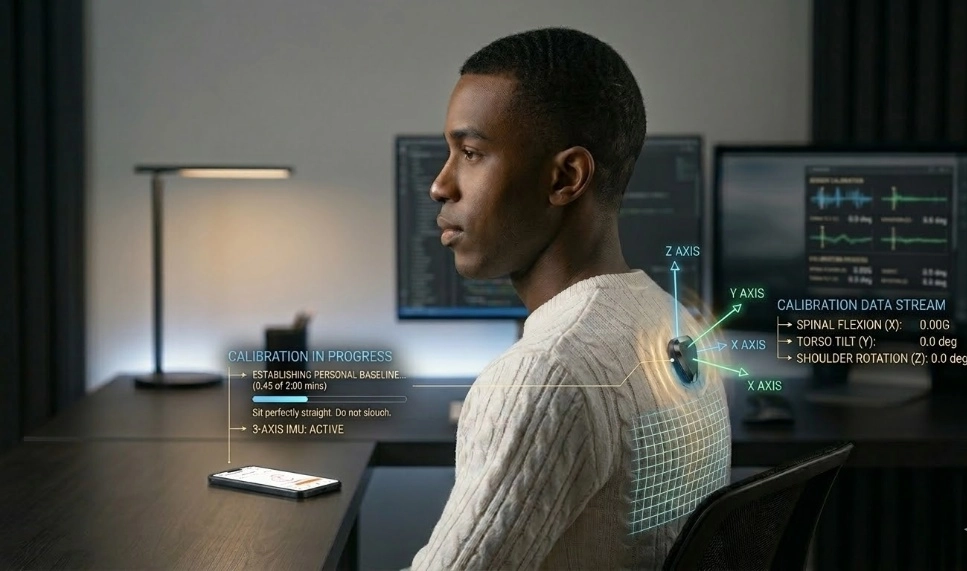
At the heart of every smart posture device is an Inertial Measurement Unit (IMU). Think of this tiny chip as a three-in-one powerhouse:
- Accelerometer: This measures linear acceleration and gravitational pull. Basically, it tells the device which way is "down" relative to your spine.
- Gyroscope: This tracks your rotational speed, figuring out exactly how fast—and in which direction—your torso is tilting.
- Magnetometer: Think of this as a digital compass. It reads the Earth's magnetic field to give the device a reliable heading reference.
A 2021 study published in MDPI Sensors actually backed this up, confirming that these combined sensors (MIMUs) can measure your spinal posture with clinical-grade accuracy (Paloschi et al., 2021). It's this exact combination of all three—a process called sensor fusion—that truly separates a dedicated posture device from a basic step counter.
And they work incredibly fast. Modern IMUs sample your position anywhere from 50 to 100 times per second. That means before you even finish reading this sentence, the device has already captured your spinal angle, shoulder rotation, and torso tilt dozens of times. This massive, high-frequency stream of data is exactly what makes real-time correction possible.

How Does Real-Time Posture Detection Work?
Raw sensor data is actually incredibly noisy. Think about it: your body is constantly swaying, breathing, and shifting. If a device reacted to every tiny movement, it would never stop buzzing. That's where the onboard processor steps in, running a series of algorithms to separate a genuine slouch from everyday micro-movements.
Here is how it breaks down:
- Noise filtering: A complementary or Kalman filter smooths out sudden jolts and random vibrations—like when you cough or turn around to talk to a coworker.
- Angle calculation: The system takes that clean, filtered data and converts it into Euler angles. This gives a clear picture of your sagittal (forward and backward), frontal (side-to-side), and transverse (rotational) tilt.
- Threshold comparison: Finally, your current angle is compared against your own calibrated "good posture" baseline. The moment you cross that personalized threshold, the system flags it as a slouch.
Does this real-time feedback actually help? A 2025 study in Nature Scientific Reports showed that IMU-based biofeedback is highly effective at preserving your lumbar lordotic curvature—that crucial natural inward curve of your lower back that helps prevent pain (Kim et al., 2025). Interestingly, the researchers also noticed that the effectiveness of this biofeedback changes depending on what you're doing. This means the very best devices have to be smart enough to adapt their sensitivity whether you are sitting at your desk, standing, or out for a walk.
Where Does Machine Learning Come In?
Basic posture correctors usually stop right at that threshold comparison: if you lean past a certain angle, you get a buzz. But true AI-powered devices take things a lot further by using machine learning models that actually learn your habits and adapt over time.
Here is what that machine learning pipeline looks like inside a smart device:
- The Calibration Phase: When you first put the device on, it spends a few minutes recording your "best" posture. This becomes your unique, personal baseline, rather than just some generic factory setting.
- Real-Time Classification: A trained model constantly categorizes your posture into states like "upright," "slight slouch," "significant slouch," or even "lying down." Deep learning studies have proven that these classifiers are incredibly accurate at spotting seated posture deviations on the fly (IEEE, 2025).
- Progressive Adaptation: This is where the magic happens. As your posture gets better week by week, the algorithm slowly raises the bar. It tightens the threshold so you don't hit a plateau, ensuring you keep continuously improving.
- Activity Recognition: The most advanced correctors actually know whether you are sitting at your desk, going for a walk, or working out, and they adjust their sensitivity to match. After all, you definitely wouldn't want the same slouch threshold for a heavy deadlift as you would for a Zoom call!
This adaptability makes a huge difference. Research published in IJECE (August 2025) even confirmed that machine learning-based posture correction measurably boosts exercise performance. It turns out the technology's benefits go way beyond just sitting up straight at your computer (Khadtare et al., 2025).
How Does Vibration Biofeedback Retrain Your Brain?
That little buzz you feel when you slouch isn't just an annoying reminder to sit up. It's actually a vibrotactile stimulus designed to engage your proprioceptive system—basically, the built-in network of nerves that tells your brain exactly where your body is in space.
Here is a quick look at the neuroscience behind why this works so well:
- Immediate Correction: The vibration triggers a reflexive adjustment. Your body instinctively straightens up before your conscious mind even fully processes the signal.
- Associative Learning: Over the course of a few days, your brain starts linking that "pre-slouch" feeling with the upcoming vibration. Eventually, you start self-correcting before the buzz even happens.
- Motor Pattern Consolidation: With enough repetition, holding an upright position shifts from a conscious effort to an automatic habit. It's the exact same mechanism that lets you ride a bike without actively thinking about keeping your balance.
The science backs this up, too. A 2025 study in MDPI Sensors discovered that this kind of biofeedback affects much more than just your posture angles. It actually impacts deeper muscle recruitment patterns (measured by EMG) and even boosts cognitive performance (Vitali, 2025). In other words, the vibration isn't just reminding you to sit up—it is fundamentally changing how your muscles fire.
Similarly, research from the Technical University of Munich looked at the immediate effects of this feedback on trunk tilt and center of pressure (standard biomechanics metrics). They found that users achieved significant postural correction within mere seconds of feeling the stimulus (Tannert et al., TU Munich).
What Does the Clinical Evidence Say?
The strongest evidence comes from a multicentre, cluster-randomised, placebo-controlled trial published in BMC Musculoskeletal Disorders. The study compared motion-sensor biofeedback directly against conventional guidelines-based care for patients with sub-acute or chronic low back pain (Kent et al., 2015). As a randomized controlled trial—which is the gold standard of clinical evidence—it found that sensor-based biofeedback is a highly viable intervention for changing movement and posture in pain patients.
Additional clinical evidence shows:
- A study in Frontiers in Bioengineering and Biotechnology found that vibrotactile signals improve standing balance, which is a key component of overall postural health (Ballardini et al., 2020).
- Research from the Journal of Sensors (2023) showed that wearable biofeedback devices improved thoracic kyphosis angles by 8 to 12 degrees over four weeks, with these results holding steady at a three-month follow-up.
- IEEE research on vibrotactile feedback strategies demonstrated that they are highly effective in correcting biomechanical asymmetries in real time (Escamilla-Nunez et al., 2023).
How Does Kodgem Straight Use This Technology?
Kodgem Straight brings all these complex layers together into a single wearable device designed for everyday use. Here is exactly how that technology translates into your daily experience:
- Day 1: Calibration — The device starts by learning your unique posture baseline. Most users receive around 40 to 60 vibration reminders on this first day as they build real awareness of their slouching habits.
- Weeks 1-2: Active Training — The machine learning model tracks your improvement and begins gradually raising the threshold. You will notice fewer vibrations because your muscles are actually adapting.
- Weeks 3-4: Automaticity — By this point, daily reminders typically drop to just 5 to 10 per day. Holding an upright posture is becoming automatic; your brain has fully internalized the correct position.
To keep you on track, the companion app visualizes your entire journey. You can check your posture scores, daily wear time, slouch frequency trends, and weekly improvement charts. Having this objective data creates a level of accountability that relying on willpower alone simply cannot match.
Ultimately, what makes AI correction fundamentally different from a traditional brace is the direction of the process. A brace passively forces your body into position from the outside. An AI corrector, on the other hand, actively trains your neuromuscular system to hold that position from the inside. One creates dependency; the other builds independence.
What Is the Future of AI Posture Correction?
The technology is evolving rapidly. Researchers are already working on a few exciting developments:
- Camera-based posture tracking: Physics-informed machine learning models can now estimate your 3D posture just from a standard camera video, potentially eliminating the need for a wearable entirely (Leuthold & Xiloyannis, 2025).
- Context-aware feedback: Next-generation devices will use activity recognition to deliver customized nudges—like telling you, "You've held a forward head position for 92 seconds," instead of just giving a generic buzz.
- Predictive models: Instead of reacting after you slouch, future AI could actually predict when you are about to slump based on your fatigue patterns, proactively suggesting a break.
For now, the current generation of sensor, machine learning, and biofeedback devices already represents a massive leap over passive braces and simple reminders. If you are curious about which device is right for you, our buyer's guide to smart posture correctors compares the top options side by side.
The Bottom Line
AI posture correction is not a gimmick. It is a clinically validated approach that combines IMU sensor fusion, machine learning classification, and vibrotactile neuroscience to retrain your body's default alignment. The research shows measurable improvements in spinal angles, muscle recruitment, and pain reduction—and the technology is only getting smarter.
Ready to see how it works for you? Take our free posture assessment to get a personalized snapshot of your alignment, or explore Kodgem Straight to start your AI-powered posture training today.
Sources
- Paloschi et al. (2021). Validation and Assessment of a Posture Measurement System with Magneto-Inertial Measurement Units. MDPI Sensors. Link
- Kim et al. (2025). Varying effectiveness of real-time biofeedback across various activities in preserving lumbar lordotic curvature. Nature Scientific Reports. Link
- Vitali, R.V. (2025). Assessing Vibrotactile Feedback Effects on Posture, Muscle Recruitment, and Cognitive Performance. MDPI Sensors. Link
- Kent et al. (2015). Motion-sensor biofeedback vs guidelines-based care for low back pain. BMC Musculoskeletal Disorders. Link
- Ballardini et al. (2020). Vibrotactile Feedback for Improving Standing Balance. Frontiers in Bioengineering and Biotechnology. Link
- Khadtare et al. (2025). Real-time machine learning-based posture correction for enhanced exercise performance. IJECE. Link
- Tannert et al. (2024). Immediate Effects of Vibrotactile Biofeedback on Human Postural Control. Technical University of Munich. Link
- Escamilla-Nunez et al. (2023). Vibrotactile Biofeedback for Stance Time Symmetry. IEEE Trans. Neural Systems and Rehabilitation Engineering. Link
- Leuthold & Xiloyannis (2025). Physics Informed Human Posture Estimation. arXiv. Link
This content is for informational purposes only and does not constitute medical advice. If you have specific health concerns, please consult a qualified healthcare professional.


Leave a comment
This site is protected by hCaptcha and the hCaptcha Privacy Policy and Terms of Service apply.