
Shops use three names for the same aisle: posture trainer, posture corrector, posture brace. They are not the same object.
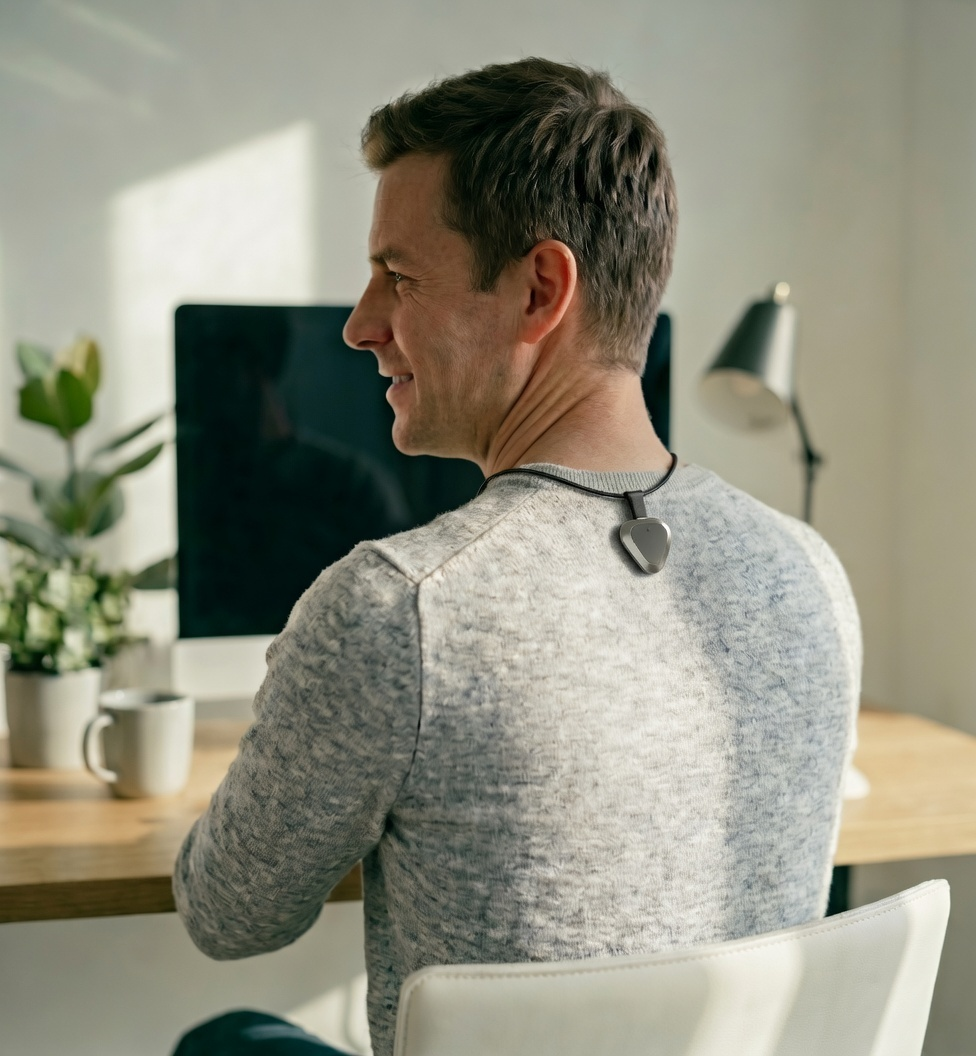
A wearable posture corrector is a small sensor on your upper back. When you slouch and stay there, it buzzes. You sit up yourself. Nothing pulls your shoulders.
A brace is elastic. It yanks you tall for as long as it is on. Take it off and you have the same slouch you walked in with.
What you are holding
Most wearables are a puck, smaller than a matchbox. Inside is a motion sensor, a tiny motor for the buzz, and a battery. You wear it between the shoulder blades. A pad sticks it to skin, or a clip or necklace hangs it on a shirt.
You sit as tall as you reasonably can and save that as the baseline. Then you work. Reach for a mug and you lean. That is fine. Stay folded over the keyboard for a minute and the puck buzzes. You stack your head back over your shoulders. The buzz stops.
That loop can fire twenty times before lunch. The habit is those reps, not one perfect hour.
How it differs from the rest of the aisle
A back brace uses straps. The garment does the lift. You look taller in a mirror in a few seconds. You also feel the elastic by lunch, and it often shows under a white shirt. If you wanted that kind of pull, read AI posture corrector vs back brace.
A posture shirt or reinforced bra is fabric with extra stiffness. It hints. It does not buzz, and it does not log a slouch.
A phone timer that says “check your back” has no sensor on you. It pings while you are already sitting well. Useful for a week if you only want to know whether reminders irritate you. Then you either buy hardware or you don’t.
The names on the box
Brace means straps. They do the work.
Wearable trainer, smart trainer, and wearable posture corrector mean a sensor. You do the work when it taps you.
AI posture corrector is usually the same sensor plus software that tries not to buzz when you tie a shoe. The useful part is the wait. The word AI on a box does not mean a diagnosis.
Search still dumps the $15 brace next to the $150 sensor. If you landed here from “posture corrector,” pause on which object you actually want.
Pads, clips, and a full desk day
How it stays on decides whether you still wear it in week four.
Adhesive pads are cheap on day one. They dry out. Daily wear means a refill sleeve on the shelf, and some skins hate the glue. A clip or a necklace mount costs more up front and nothing by month four. Same cue. No daily sticker.
Weight matters. If you feel the puck on every breath, you will take it off. The ones people keep are light enough to forget until they buzz.
Under clothes, a puck is a small lump. A brace is a harness. If you take video calls in a thin shirt, that difference shows up before any app chart does.
The first week
Day one is noisy. You have been folding for years. The puck treats that as news. You will sit up, slump, sit up again. Some people overcorrect and end up rigid, which is its own ache. Loosen the baseline if every reach sets it off. The point is a cue you can live with, not a military spine.
By day four the false buzzes decide the purchase. A fixed angle fires when you turn to a colleague. Adaptive software is supposed to wait for a slouch that stays. If it still nags through normal movement, you will leave it in a drawer. That is not a willpower problem. That is a threshold problem.
Wear it in the hours you actually slouch. For most people that is the desk block, not the whole calendar. A two-hour session you finish beats an all-day plan you abandon at 10:30.
Sitting, standing, walking
The sensor lives on your upper back, so it notices that region. Shoulders rounding over a laptop. Head drifting toward the screen. It does not run a full-spine exam. A lumbar complaint is a different product, often a belt, and often a clinician first.
At a desk it has a clean job: you stay in one shape for too long. Standing at a counter, the same lean can be work, not a slouch. Walking, you flex on purpose. A dumb threshold will hate both. This is why people shop for software after they have already owned a puck.
Webcam apps only see you where the camera sees you. They do not follow you to the kettle. A wearable does. If your slouch is desk-only and you refuse a puck, try the camera first. If you slouch on calls around the house, you still need something on your back.
What the software is for
Apps may add a practice block, a quiet day, or a weekly slouch count. A dashboard you never open is wasted money. If you will not look at the chart, buy the cue, not the extra software.
Charging is part of the habit. Most pucks last days, not hours, then sit on a cable overnight. Forget the charge and you have a silent lump. That is annoying. It is also simpler than a brace you have to wash.
None of this is a medical reading of your spine. It is a reminder with a clock on it.
What it cannot do
It will not rebuild a spine. It will not replace walking around or a stronger back. Clinic pages that lump every “posture corrector” together are talking about braces, shirts, and sensors as if they were one treatment. They are not. A consumer puck is a tap. The sit after you take it off is only the reps you already did.
If a listing promises a cured back in two weeks, it is selling the search, not the object.
What to check before you buy
Mount first: pad, clip, or both. Then false buzzes. Then whether you will wear it for the hours you slouch. Then whether you will open an app.
Price the year, not the box. Pads and stretched braces add up. A clip you buy once can beat a cheaper puck you refill.
Five questions, no brands: how to choose a posture corrector. The topic page for the habit, not the gadget, is the posture correction guide.
When this category is the wrong buy
Want a cue you can take off later? This is the category. Want instant shape in a photo? Buy a brace and know what you bought.
A low laptop will beat any buzz. Set the screen so you are not reaching. The desk height calculator on this site is a helper, not a product in a cart.
Pain that stays, a named back problem, or a recovery plan belongs with a clinician. A consumer puck is a reminder.

Leave a comment
This site is protected by hCaptcha and the hCaptcha Privacy Policy and Terms of Service apply.