
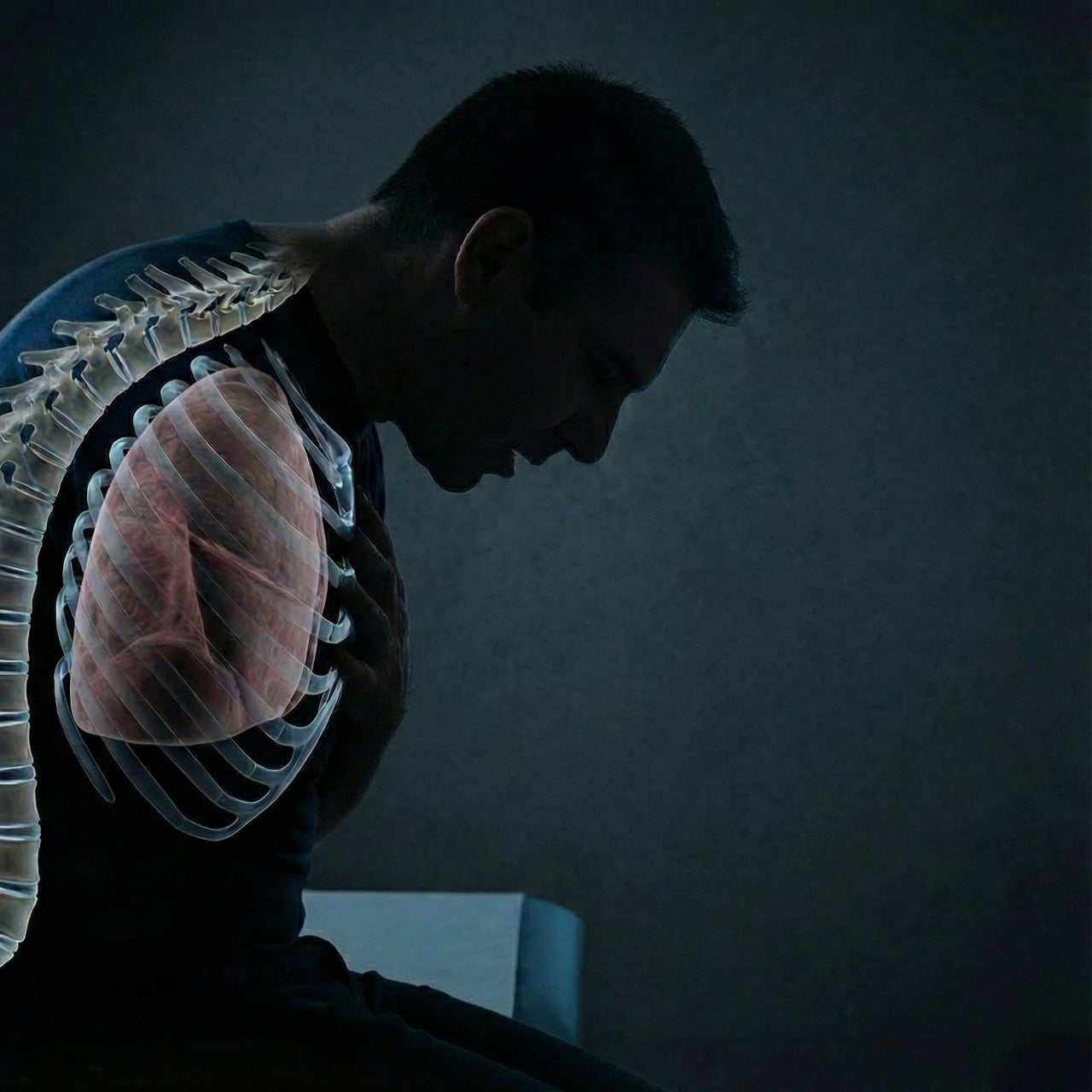
The hunched posture that many of us unconsciously adopt in daily life is not merely an aesthetic issue. In the long term, it can have direct effects on breathing, lung capacity, and overall quality of life. In this article, we examine the relationship between poor posture, postural disorders, and breathing based on scientific sources.
What Is Hunching (Thoracic Kyphosis)?
What is commonly referred to as hunching is most often medically defined as thoracic kyphosis. This is an excessive forward curvature of the upper (thoracic) spine.
The Cleveland Clinic explains this condition as follows:
“Severe kyphosis can cause shortness of breath or difficulty breathing.”
How Does Poor Posture Affect Our Breathing?

1. Chest Wall Movement Is Restricted
During inhalation, the rib cage needs to expand. A hunched posture limits this mechanical expansion.
The Framingham Spine Study describes this as:
“Increased kyphosis reduces thoracic cavity space, limiting rib mobility and lung expansion.”
Over time, this can lead to shallow breathing, rapid fatigue, and a sensation of shortness of breath.
2. The Diaphragm Works Less Efficiently
The diaphragm is the primary muscle responsible for breathing. However, when the spine collapses forward, the diaphragm’s up-and-down movement becomes restricted.
Studies have shown that respiratory muscle strength decreases in a slouched sitting position:
“In a slumped sitting posture, inspiratory muscle strength is lower compared to an upright sitting position.”
3. Lung Capacity Can Measurably Decrease
A systematic review published in 2018 showed that an upright body position positively affects respiratory function:
“In most studies, FEV1 and FVC values were found to be higher in upright positions.”
- FEV1 (Forced Expiratory Volume in 1 second) refers to the amount of air forcefully exhaled in the first second after a deep breath. It indicates airway openness and the speed of exhalation.
- FVC (Forced Vital Capacity) is the total volume of air forcefully exhaled after a deep inhalation. It reflects lung capacity and the ability of the rib cage to expand.
These findings support a direct relationship between poor posture and reduced lung capacity.
What Changes Occur in Breathing With Poor Posture?
- More shallow breathing
- Faster fatigue when climbing stairs
- A feeling of tightness in the chest during deep breaths
- Decreased FEV1 and FVC values
- Excessive tension in the neck and shoulder muscles
Why Is Posture So Important in the Posture–Breathing Relationship?
Scientific evidence shows that many breathing problems often stem not directly from the lungs themselves, but from mechanical restrictions caused by postural disorders.
For this reason, not only breathing exercises but also posture awareness and postural training are essential parts of the process.
This is where the Kodgem Straight approach comes into play.
What Is Kodgem Straight?

Kodgem Straight is an AI-powered posture training device that, when worn on your back, analyzes your spinal and shoulder angles using intelligent sensors. When poor posture is detected, it alerts you through biofeedback vibrations. With its mobile app, users can track posture data through graphs and statistics.
This approach aligns with modern, science-based methods for managing hunching, postural disorders, and posture-related breathing problems.
What Makes Kodgem Straight Different From Others?
Most posture-correcting products—especially braces and elastic bands—work passively. They pull the shoulders back, force the body into a fixed position, and may lead to muscle laziness over time.
Kodgem Straight, on the other hand, offers an active, awareness-based system:
-
Active awareness, not passive correction
When incorrect posture is detected, the user is alerted and corrects their posture using their own muscles, promoting long-term postural habits.
-
AI-powered, personalized analysis
It distinguishes between desk work, reading, tablet, and computer usage habits to provide accurate posture analysis.
-
Measurable progress via mobile app
Daily posture scores, upright sitting duration, and weekly progress are tracked through visual graphs.
-
All-day comfort
Its lightweight design is discreet under clothing and suitable for long-term use.
-
Builds muscle memory
Its guiding—not forcing—structure helps embed correct posture into muscle memory, contributing over time to improved breathing mechanics.
Conclusion
- Poor posture can negatively affect breathing capacity
- The effect occurs mainly through chest wall and diaphragm mechanics
- Breathing quality cannot improve permanently without correcting posture
- Kodgem Straight supports this process with its active, awareness-based approach


Leave a comment
This site is protected by hCaptcha and the hCaptcha Privacy Policy and Terms of Service apply.